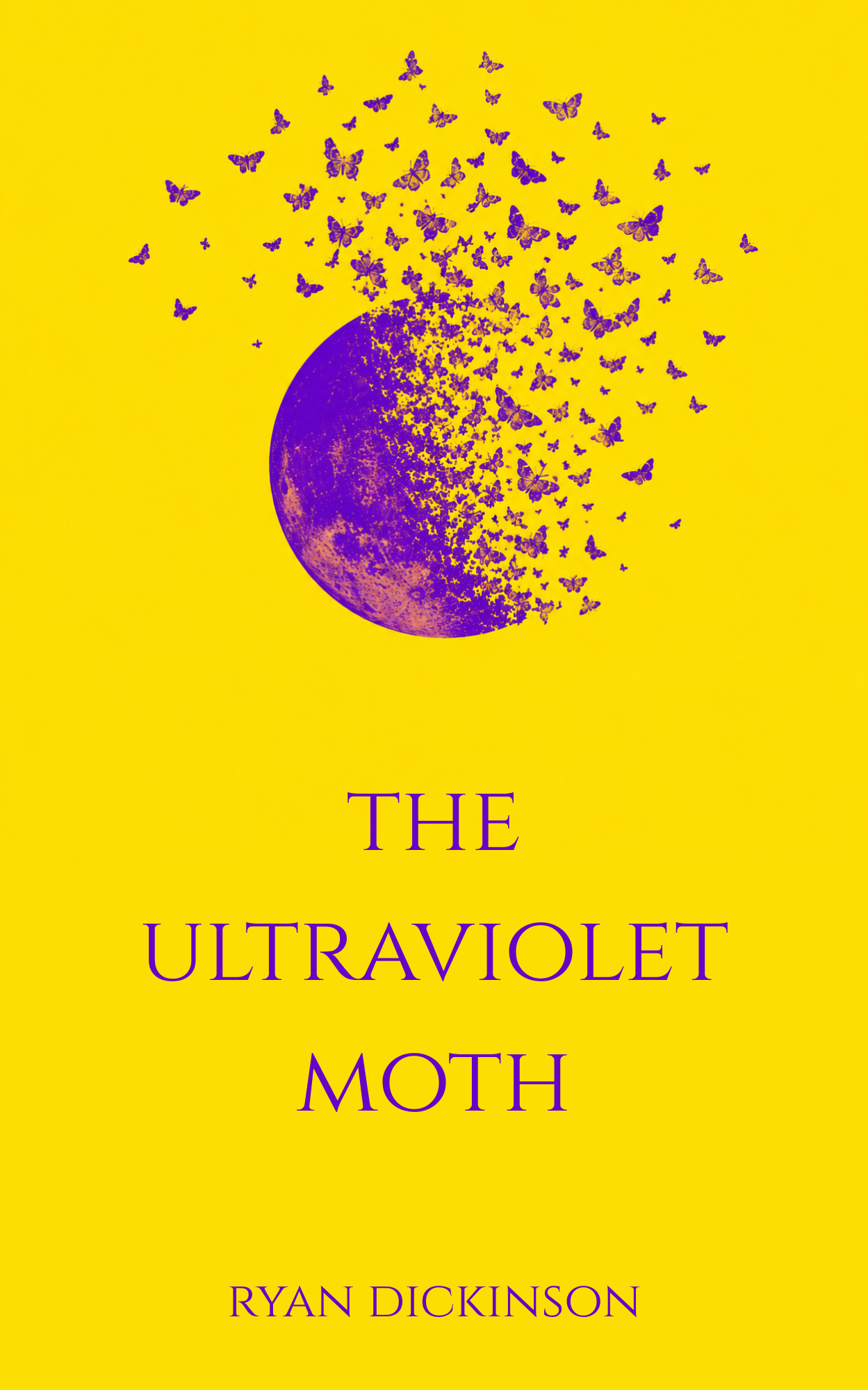
The Ultraviolet Moth
The Ultraviolet Moth
Couldn't load pickup availability
A river runs through a village-city that is slowly becoming more city than village. On its bridge, a young orphan sings the weary home from the factories — a child held alive by the small kindnesses of strangers, by the leftovers of a candle-lit restaurant, by a stolen seat at the local theatre.
Then a man in the highest tower of the industrial quarter reaches into a dream and catches something he was never meant to touch: a pair of ultraviolet moths, brilliant beyond reason. He traps them. He multiplies them. He gives them, one by one, to the village-city.
What follows is a slow, terrible enchantment. The villagers fall silent. Their gait slows, their eyes dull, their laughter shrinks into the spaces between glances at the glass. The boy is forgotten. He grows hungry. And in the shadows of his alley, a creature with a spiralling staff and a deep-well voice offers him a bargain — bring me the moths, and I will feed you.
The Ultraviolet Moth is a short mythopoetic fable — a 78-page allegory written in the lyrical register of Ryan Dickinson's poetry — about a community under a spell it doesn't know it's living, and the figures who move through it: the orphan, the trickster, the lost scientist, and the dream. It is a story about the cost of fantasy, the necessity of disturbance, and the songs that survive even the deepest forgetting.
For readers of Paulo Coelho, Kahlil Gibran and Ursula K. Le Guin.